
A Modern Voicing Platform for Allen Organ
The challenge

The instruments outgrew the software that voiced them

Allen Organ Company has been building organs in Pennsylvania since 1937. They introduced the first digital organ in 1971. Today, it is the world’s largest maker of digital church organs.

One of the most important parts of that work is voicing, and it happens in a room, not at a desk. After an Allen organ is installed, a specialist sits at the instrument with a laptop. They listen to how it sounds in that particular space and adjust the organ until it sounds right there. Voicing is central to Allen's craft. The company likes to say the most important stop on any organ is the room it's placed in.

Allen has built digital organs since 1971, and for decades DOVE was the software at the center of that work. It served Allen well, and it carried much of what the company had learned about adjusting its instruments. But Allen's latest instrument technology needed the organ and the software to communicate in ways DOVE was never built for. No update to screens or features would fix that, because the problem sat in how the application talked to the instrument.

So Allen stopped patching and decided to build a replacement from scratch. That meant changing everything underneath the tool without losing the working knowledge that made it useful.

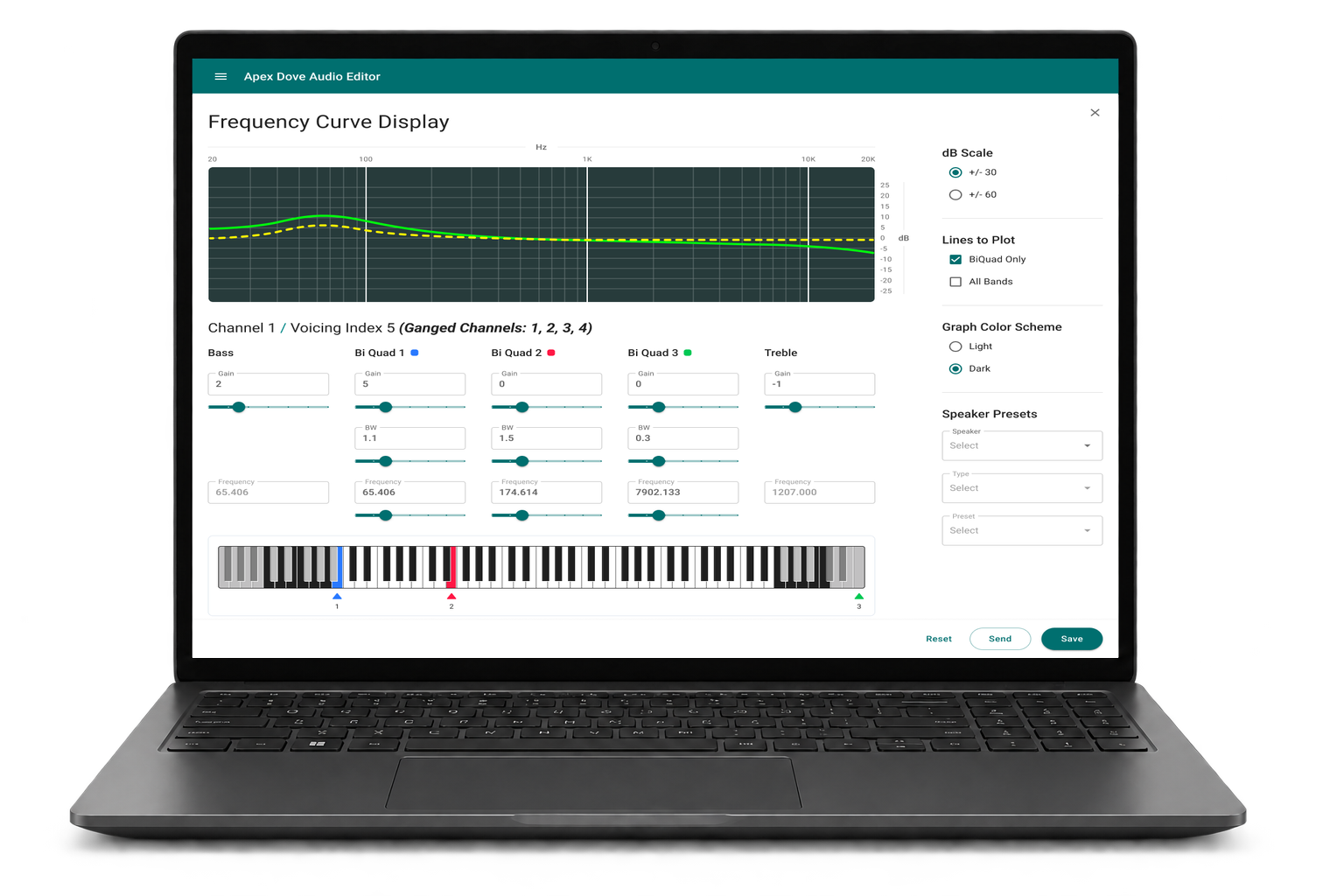
LARK organ voicing software shown on a Windows laptop.

LARK gives Allen’s specialists a clear Windows workspace for voicing instruments in the room.

The solution

A Windows platform built around the work of voicing

LARK is a Flutter application for Windows, built to support the session that happens beside the instrument. A specialist connects to the organ, listens, makes an adjustment, and listens again.

Its user experience design follows how Allen's specialists move through a session: which adjustments belong together, and what someone needs to see before sending a change to the instrument.

LARK isn't a general audio editor. It's software built specifically for adjusting the sound of an Allen organ.

Core components

Designed around a real voicing session

The application follows the way Allen's specialists actually work beside an instrument. Each part supports a specific step in the session without pulling attention away from the sound in the room.

Laptop connecting to an Allen organ on the local network.

Organ discovery and retrieval

LARK finds compatible organs on the local network and retrieves the instrument's current settings before any adjustment begins. The specialist works from what's actually loaded on the organ in the room, not from an older file.

Focused controls for adjusting an Allen organ during voicing.

Focused voicing workspaces

Voicing covers individual voices, frequencies, tremulants, key regions, and channel and expression behavior. LARK gives each area its own workspace, keeping the detail organized while the specialist decides what sounds right.

Protected library for backing up and recovering organ configurations.

Backup, recovery, and protected libraries

Backing up an organ, restoring one, or sending changes is not a casual click. LARK confirms consequential actions, checks transfers, shows progress, and provides clear recovery states. Retrieved configurations remain available in protected local libraries.

One shared LARK application supporting Factory and Dealer configurations.

Factory and Dealer configurations

Allen's factory team and dealer network need different things from the same tool. LARK ships as Factory and Dealer versions built on one shared foundation, so Allen maintains one application while each group gets software focused on its work.

The process

Learning a craft while the hardware kept moving

None of this could come from a spec sheet. Voicing knowledge lives with Allen's specialists. Building LARK meant learning from them what voices, tremulants, and key regions mean to the people who adjust them, along with how a session actually unfolds.

There was also no finished target to build against. Allen was developing its newest instrument hardware at the same time, so the way the organ and the application communicate kept evolving while both took shape. When the hardware changed, the software followed.

Testing happened at several levels. Automated tests covered the application logic on its own. An organ simulator made hardware-dependent behavior repeatable, so development could keep moving without an instrument in the room. The simulator was never a substitute for real hardware, though, so LARK was also validated on physical organs over live networks. The Windows installers for both the Factory and Dealer versions were tested as well, since the installer is part of what Allen and its dealers actually receive.

Both teams came away with a clear takeaway. On specialized work like this, it pays to define workflows, hardware boundaries, failure cases, and acceptance criteria in more depth before full implementation begins. That's where we'd invest first on the next project like it.

The outcome

Stable software at the start of a long rollout

In May 2026, Allen introduced LARK to its dealer network alongside the new instrument technology it was built to support. Allen now has what it set out to get: a single, maintainable Windows application for its voicing work. It was built for Allen’s latest instruments and is expected to serve its team and dealers for years.


Allen’s specialists are already using LARK for the work it was built to do. It connects to the organ, loads its current settings, and lets the specialist adjust and save how it sounds in the room. 


The rollout is early because the instruments themselves take time. Allen organs are built to order. A new instrument usually takes four to five months to build and install, and a large one can take a year. Organs on the new platform are just beginning to reach the rooms where they’ll be voiced. Dealers are only starting to use LARK, but Allen says it has been very well received so far.


Responsible for software your business depends on?

If aging, specialized, or hardware-connected software is holding back what’s next, we can help you decide whether to update or rebuild.

SBA CERTIFIED

We’re a SBA Certified Small Business

541511

Custom Computer 

Programming Services

511210

Software 

Publishers

541512

Computer System 

Design Services

541513

Computer Facilities 

Management Services

541519

Other computer 

related services