




Key Takeaways
-
Precision fertilization depends on scalable data infrastructure because sugarcane mills need to analyze thousands of fields without overusing fertilizer.
-
AWS Fargate helps support unpredictable demand by scaling containerized workloads when farmers need Fieldlook insights.
-
A loosely coupled architecture makes the platform easier to evolve because the UI, API, compute, data storage, and orchestration layers can change independently.
-
S3, Aurora PostgreSQL, and Dagster support large-scale data processing for satellite-driven crop analysis and fertilization recommendations.
-
The business impact is measurable: precision fertilization can improve productivity per hectare without increasing fertilizer usage.
Precision Fertilization at Scale
Modern agriculture increasingly depends on data. For Colombian sugarcane mills, the scale of the problem is significant: a single mill can oversee more than 5,000 fields across roughly 25,000 hectares. Monitoring that much land manually is not practical, and applying fertilizer uniformly across every field is both inefficient and expensive.
The challenge is precision. Farmers need to maximize crop growth while using the least amount of fertilizer possible. If fertilizer is applied where growth is already healthy, the mill absorbs unnecessary cost and increases environmental impact. If fertilizer is withheld from areas that need support, yield suffers.
This is where precision fertilization becomes valuable. By identifying the specific areas of a field where growth is lagging, mills can redirect fertilizer to the places where it creates the greatest return. That requires more than a dashboard. It requires a scalable data science and AI platform that can process satellite data, run complex calculations, and deliver actionable recommendations to farmers when they need them.
Fieldlook and Satellite-Driven Agriculture
eLEAF provides satellite-based data to agricultural customers through Fieldlook, an application that uses machine learning to advise farmers and agricultural teams. For sugarcane mills, Fieldlook helps translate large-scale field data into practical fertilization decisions.
The application needs to support real-world agricultural operations. Farmers may not use the platform at perfectly predictable times, but when they do, the workload can become compute intensive. Satellite-driven crop analysis, field-level recommendations, and large data requests all require infrastructure that can handle bursts without forcing the customer to overprovision resources year-round.
To support this workflow, the system was designed as a loosely coupled cloud architecture using AWS components and an Itility Data Foundation approach. The goal was to create a platform that could scale, evolve, and process large volumes of agricultural data without becoming brittle.
The Cloud Architecture Behind Fieldlook
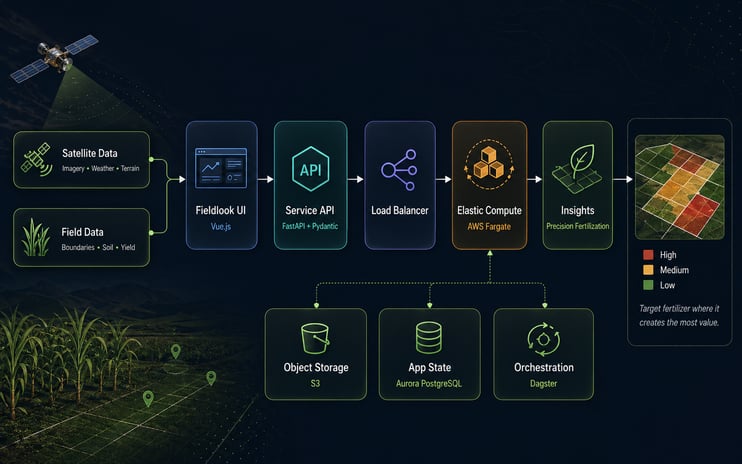
At the center of the architecture is a service API. This API creates a flexible boundary between the user interface, application logic, data processing, and infrastructure layers. That separation matters because it allows individual components to be renewed, replaced, or scaled without disrupting the entire platform.
Fieldlook users access the system through a Vue.js interface. Vue.js supports efficient front-end development and helps reduce repetitive implementation work. Requests from the UI are handled through FastAPI, a high-performance Python framework that is well suited for API-driven systems.
Pydantic is used to support data validation and structure. In a data-heavy workflow, validation is not a minor detail. It helps ensure that the API receives and returns consistent data, reducing downstream errors in processing and analytics.
How AWS Fargate Supports Variable Demand
One of the core infrastructure requirements was elasticity. Agricultural users do not always create steady, predictable traffic. Demand can rise when field teams need recommendations, when processing windows open, or when new data is available for analysis.
AWS Fargate provides a strong fit for this workload because it allows containerized services to run without managing underlying servers. The platform can scale compute resources as needed while reducing operational overhead. Combined with reusable Data Foundation building blocks, Fargate helps process large-scale agricultural data without forcing the team to maintain static infrastructure sized for peak demand.
An AWS Application Load Balancer sits in front of the Fargate environment. This layer helps route traffic efficiently, supports scalability, and improves security by avoiding direct exposure of the Fargate services and Data Foundation components.
Data Foundation: S3, Aurora, and Dagster
The data required to answer a farmer's request is stored separately from the application layer. Satellite data and supporting datasets live in Amazon S3, while Aurora running PostgreSQL manages structured metadata and application state.
This separation keeps the architecture flexible. S3 is well suited for large object storage and data lake patterns, while Aurora PostgreSQL provides relational capabilities for structured information. Together, they create a foundation that can support analytical workloads without forcing every data type into the same storage model.
Dagster is used for data orchestration. It supports large-scale, complex calculations that turn raw data into usable insights about crop growth and fertilization optimization. In this architecture, orchestration is essential because the value is not just in storing data. The value comes from transforming data into recommendations that farmers can use in the field.
|
Component |
Role |
Why It Matters |
|---|---|---|
|
Vue.js |
Fieldlook user interface |
Gives agricultural teams a usable way to request and view insights. |
|
FastAPI and Pydantic |
API and data validation |
Supports reliable request handling and consistent data contracts. |
|
AWS Fargate |
Autoscaling compute |
Handles bursts in demand without managing servers directly. |
|
S3 and Aurora PostgreSQL |
Data storage and metadata |
Separates large satellite datasets from structured application data. |
|
Dagster |
Data orchestration |
Coordinates complex calculations that generate fertilization insights. |
Business and Sustainability Impact
Fieldlook enables precision fertilization by helping mills apply fertilizer where it is needed most. That supports a better balance between yield, cost, and environmental responsibility.
The impact can be significant. By redirecting fertilizer from areas already showing optimal growth to areas where growth is lacking, sugarcane mills can see a productivity increase of roughly 6% to 14% per hectare without using additional fertilizer. With an average yield of 100 tons per hectare valued at approximately EUR3,500, that can translate into an additional EUR200 to EUR500 in revenue and margin per hectare.
For a mill operating across 25,000 hectares, small per-hectare improvements can become material business outcomes. Just as important, the platform supports more responsible fertilizer use, helping reduce unnecessary environmental impact while improving operational performance.
Why This Architecture Matters
This architecture is a useful example of how cloud infrastructure, data engineering, and machine learning can support real-world sustainability outcomes. AWS Fargate provides scalable compute. The Application Load Balancer improves routing and security. S3, Aurora PostgreSQL, and Dagster support the data foundation. The API layer keeps the system modular. Machine learning turns large agricultural datasets into field-level recommendations.
The result is not technology for its own sake. It is an AI-powered platform designed to help agricultural teams make better decisions at scale.
For organizations building similar systems, the pattern is broadly applicable: decouple the architecture, validate data at the API boundary, use elastic compute for variable demand, separate storage models by data type, and orchestrate data pipelines so insights are delivered reliably.
Building AI-Ready Cloud Platforms
AI applications need more than models. They need dependable cloud foundations that can scale, process data, secure services, and deliver results to users in the moments that matter. Whether the use case is agriculture, energy, logistics, or operations, the same principle applies: successful AI software depends on the quality of the underlying platform.
Seamgen helps teams design and build custom software, Digital Transformation platforms, and AI-enabled systems that turn complex data into practical business outcomes.
More Cloud and AI Related articles
The Agentic Software Development Life Cycle
LLM Security: Protecting Your AI Applications from Critical Vulnerabilities



Contact
sales@seamgen.com
We’re ready for you! Fill out the fields below and our team will get back to you as soon as possible.